A near-disaster
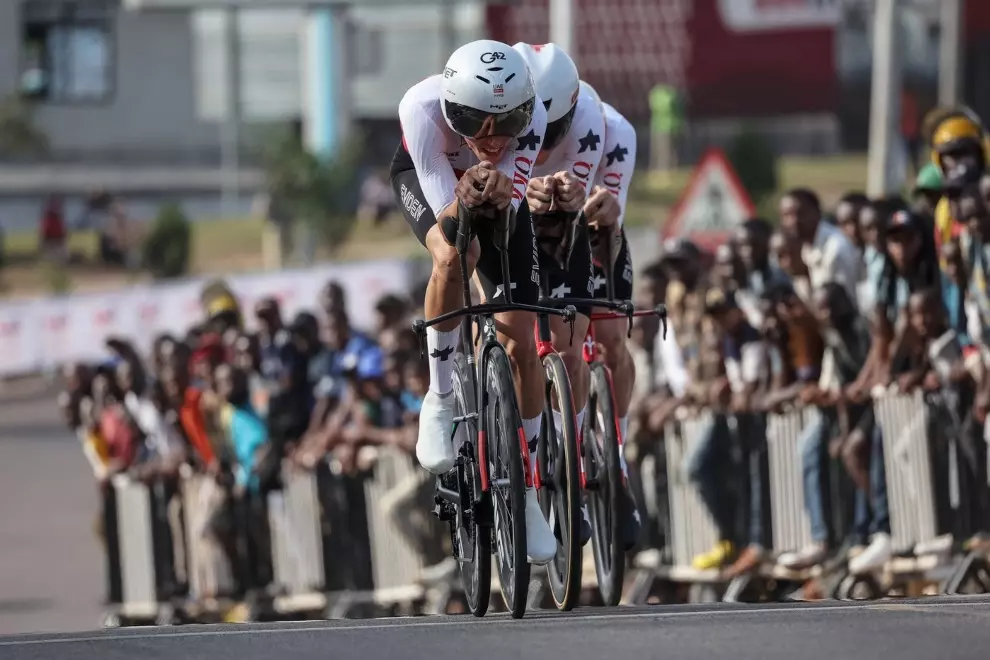
Ironically, the most dramatic mechanical of the event so far occurred on a stretch of smooth asphalt about halfway through the final lap of Wednesday’s mixed relay race, when newly crowned Elite Women’s ITT world champion Marlen Reusser’s bike broke down. She tried several times to make it work, but was finally forced to change bikes. By that time, she was several hundred meters behind her teammates. This had the potential for absolute disaster because the final time of the time trial races is taken when the second of the three riders crosses the finish line.
But amazingly, she made her way back to her teammates at the foot of the Kimihurura, and just a little later, her teammate Jasmin Liechti ran out of gas on the cobbles. Reusser and Noemi Rüegg powered up the climb and managed to save the bronze medal, 10 seconds behind winners Australia, who won their second title in a row, and 5 seconds behind France. Teammate Stefan Küng was certain that the mechanical cost Switzerland the title.
“It’s very unfortunate,” he said. “Marlen didn’t want to put it in numbers, but I am pretty sure the title was lost there. But with ifs and what ifs, we would have been world champions more times already. It’s part of the sport, it’s part of the game, and we are happy for the others. They deserve it, and we did the best we could today.”
Reusser was able to joke about, telling journalists: “We planned this yesterday, and we said, ‘You two go and then I go myself and then we catch up and then you two go’. It was a masterclass.” Then, more seriously, she added, “I think it’s hard to judge in this moment what to do, make the right decisions, and now, afterwards, we can discuss and be super smart. But sometimes it’s more about making experiences, and later, you are always super smart, so we are for sure going to discuss it and find better solutions.”
The winning team was comprised of Michael Matthews, Luke Plapp, Jay Vine, Amanda Spratt, Brodie Chapman, and Felicity Wilson-Haffenden. The Aussie men gave the women a lead of 33 seconds over France, but Cedrine Kerbaol, Juliette Labous, and Maeva Squiban rode a fantastic race, and it took a big effort by Spratt and Chapman on the Kimihurura to save the gold.
Zobrazit příspěvek na Instagramu
U23 domination
The devilish aspect of that final climb is that it’s not actually the final climb. Riders come to the top and then have a brief chance to rest before two short rises, coming close together, test their tired legs. You can sometimes hear the riders scream in their heads on the final 250 meters of the course.
Fortunately for them, the winners of the men’s and women’s U23 ITT world championships didn’t need that final climb and its diabolical aftermath to dominate their races. Sweden’s Jakob Söderqvist and Britain’s Zoe Bäckstedt were heads and shoulders above their rivals in their respective races, leading at each timing point and stretching their leads over the entire course.
The 22-year-old Söderqvist finished 1:04 ahead of New Zealand’s Nate Pringle, with French rider Maxime Decomble losing silver by a mere 0.17, less than a fifth of a second. That was the only drama of the race. As Decomble laboured over those final two bumps in the road, he seemed to have a good chance of catching the Kiwi. But he apparently misjudged the finish line and stopped pedalling about a foot too early.
This was Söderqvist’s final race as a U23; he will be riding with Lidl-Trek’s WorldTour team next year.
In Monday’s women’s race, the 20-year-old Bäckstedt – the British champion and a former junior world champion in the discipline – took 30:56 to cover the brutal 22.6 km course, winning by 1:50 over the very impressive (read below to find out why) 18-year-old Viktória Chladoňová of Slovakia. That is a gap of Evenepolian dimension. Italy’s Federica Venturelli won bronze at 2:11.
“It means a lot,” Bäckstedt said. “Hopefully, next time, I can try out for the elites.”
A French win and an amazing also-ran
I know it’s wildly premature to speak of the future potential of an 18-year-old cyclist, because so much can go wrong or a rider can hit their peak early and never progress much – but, boy, am I looking forward to seeing Chladoňová ride on the WorldTour. Three days after winning silver in the ITT, the youngest rider in the race won silver in Thursday’s U23 road race world championship, understandably running out of gas as 19-year-old Célia Gery of France powered past her just after the final rise. Chladoňová finished 2 seconds adrift, while Spain’s Paula Biasi finished third, at 0:12.
If this race is anything to go by, the Elite Men’s and Women’s road races should be real corkers. There were numerous attacks over the last two of seven laps – yes, they climbed the Kimihurura seven times – with the young Slovakian being the most active protagonist. But every time she broke away, Gery was on her wheel as the two youngsters fought a thrilling battle. But on the final ascent of the Kimihurura, Gery’s teammate Marion Bunel took charge of the lead group and charged up the ascent at full power, emptying the tank and surely riding on fumes over the final rise, where her compatriot took over.
“It’s unbelievable,” Gery said after winning the first-ever standalone U23 women’s world championship road race. Previously, it had been part of the Elite Women’s race. “It was a long time waiting, but it’s amazing. It was a masterpiece for the team. There [were] only three of us, but we managed to race perfectly. We had three very strong girls, and Marion was amazing at the finish.”
Chladoňová was rightfully delighted by her performance, saying: “I think the French team had a really good tactic, and when [Marion] attacked, I tried to follow. Célia was behind me, and we had a gap [on the pursuers], so I was happy that we had a gap. In the last few hundred meters, I think Marion from the French team gave everything for Célia. I’m also super happy that I was in the situation because it secured me a medal.” Another medal, she should have said.
This has been a thrilling World Championships so far, testing athletes to their limits, and beyond, and showcasing some wonderful young talents. But the best, hopefully, is still to come.