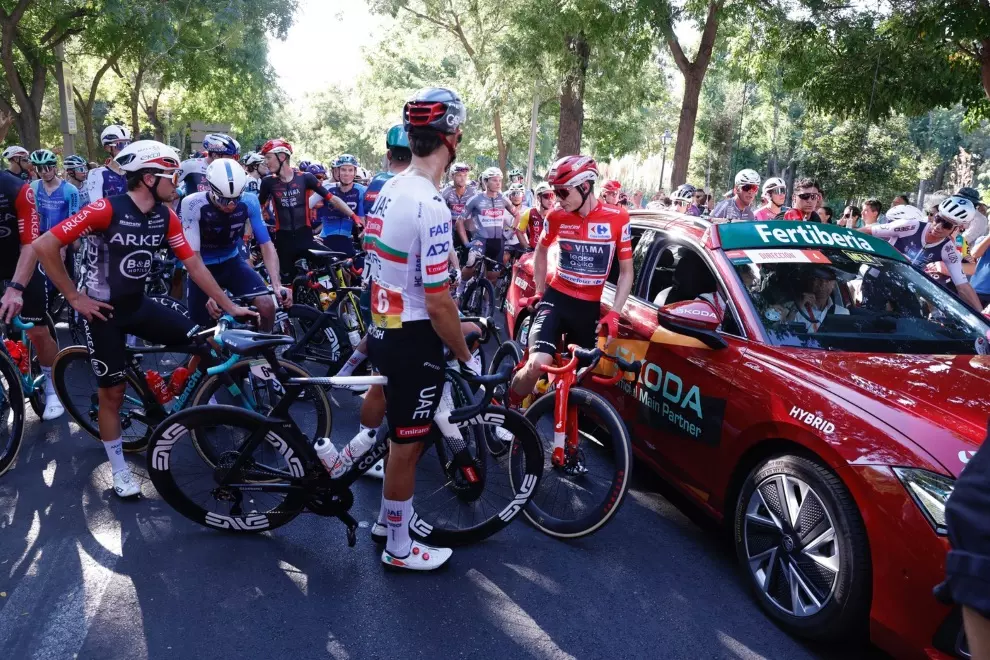
The victory on Saturday was his third stage win of the race, more than any other rider, and solidified the third Grand Tour victory of his career, after his Tour de France wins in 2022 and 2023. He might have won at least two, perhaps even three, more Tours and been celebrated as the best cyclist of his generation if not for a certain Tadej Pogačar, who has now defeated him in three Tours, including the last two. In fact, Pogačar’s recent dominance in road racing can be at least indirectly linked to Vingegaard’s 2023 Tour victory, as the Slovenian raised his skillset to another level after that defeat.
From fish to stardom
Vingegaard was working part-time in a fish factory in the town of Hanstholm [see the photos here], gutting, cleaning, and packing fish, before getting on his bike to train. He has said that this early morning work and the hard physical labor in cold conditions helped him develop the mental toughness and work ethic necessary for professional cycling. He rode for the Continental-level Coloquick-CULT team at the time, first as a stagiaire in 2016, and then as a full member in 2017 and 2018.
He registered several top-10 finishes in U23 races as well as a stage win at the 2018 Tour de l’Avenir in a team time trial. That caught the attention of Jumbo-Visma, who signed him in 2019. He won a stage of that year’s Tour of Poland, ahead of Pavel Sivakov and Jai Hindley, and rode in his first Grand Tour the following year. It was the Vuelta, which was won by Visma teammate Primož Roglič.
Roglič was also indirectly responsible for establishing the Dane as a potential Tour de France winner. Vingegaard went into the 2021 Tour as a domestique for his Slovenian teammate, but Roglič had to abandon the race after crashing on stage 8. Vingegaard was then fifth in the GC standings, 5:00 behind Pogačar, and was named team leader. He managed to finish second on both mountaintop finishes in the third week before finishing third, 27 seconds ahead of Pogačar, in the final time trial. He went on to place second in the final GC, losing only 20 seconds to the Slovenian in the remaining 13 stages. A star was born.
A terrifying crash and redemption
Last year was probably the low point in Vingegaard’s career. On a curve at the end of a low-speed descent on stage 4 of the Itzulia Basque Country, he rode over a section of the road surface that had been deformed by underground tree roots and crashed into a concrete drainage ditch. He sustained seven broken ribs, a fractured sternum, a fractured collarbone, and a broken finger, as well as bruising and bleeding around the lungs and a collapsed lung. He was rushed to a Spanish hospital and placed in intensive care. The crash significantly impacted his training and racing schedule, forcing him to miss planned training camps and races and jeopardized his riding in the Tour de France, which started less than three months later.
He made it to the Tour but without having raced a single preparatory race. That he finished second in the race and even won a stage remains for me one of his most remarkable performances. After beating Pogačar to the finish line on stage 11, he broke down in tears during the post-race interview. “Coming back from the crash, [the win] means a lot,” he said. “All the things I went through, in the last three months, . . I would never have been able to do that without my family. I’m just happy to be here. It means so much to win a stage, especially to win it for my family; they were there supporting me the whole time.”
The family is everything
If there is a single key to his personality, it is the importance to his well-being of his wife, Trine Marie Vingegaard Hansen, and their two children, daughter Frida, born in September 2020, and son Hugo, born in September 2024. He has often been seen calling home after a victory and wife and daughter have often come to the races to meet him at the finish line. He loves his children so much, in fact, that he will forbid them to become professional cyclists. Asked by Nieuwsblad if he would let his two children race when they were older, Vingegaard answered: “To be honest, if my daughter or son asks that question – ‘Daddy, can we race?’ – the answer is ‘no’. The way the sport is now… It’s just too dangerous.”
And just so we get it right, his full name is Jonas Vingegaard Hansen, as he has taken his wife’s last name, just as he took his mother’s surname, Vingegaard. According to Ororide.com, his mother, Karina Vingegaard Rasmussen, was instrumental in making her son a star road racer, helping him overcome anxiety and self-doubt and refusing to let him quit the sport due to early struggles, which were accompanied by such intense nervousness that he used to vomit due to the pressure and stress.
At this Vuelta, perhaps because he has matured, Vingegaard was uncharacteristically carefree and confident, even when illness affected his performances and there were doubts in the media that he could live up to his billing as race favorite. In fact, he also showed surprising explosiveness in the Tour, attacking when it might have been more prudent to sit back, and actually keeping up with his Slovenian nemesis on many of the big climbs. I believe that was one of the factors in Pogačar’s irritation and testiness in the second half of the race.
In fact, Vingegaard’s confidence has grown so much that he now believes that he just might be able to beat his nemesis the next time they meet in a Grand Tour. “I think this Vuelta gives me hope and belief that I can challenge him even more next year,” Vingegaard told feltet.dk. “Even at the Tour de France, although it was a clear defeat, I still took confidence from it. I had some bad days in the Tour, which I still find difficult to explain. But when I was on my best days, he couldn’t ride away from me. That makes me feel like I’ve closed the gap compared to last year.”
The trick now is to bridge that gap. But even if he never beats Pogačar again, he has already secured his place in racing history. And if he rides in next year’s Giro d’Italia, as he said he will, and wins it, he will have won all three Grand Tours, a feat only seven riders have achieved, none of them named Pogačar.