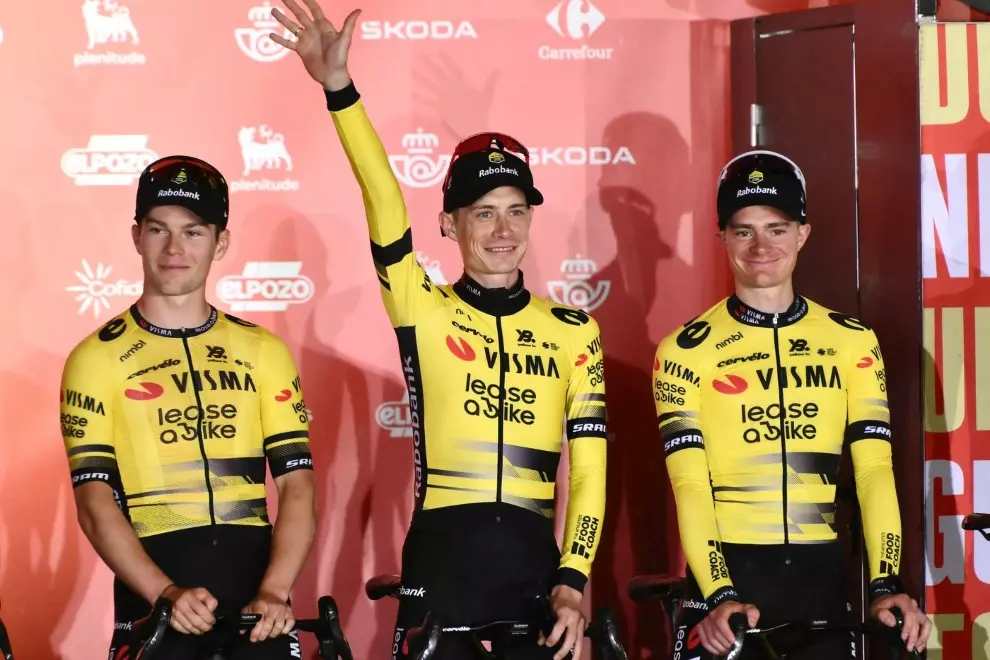
The big GC favourite
Roglič is gone, and Kuss is back in his usual role as domestique, so that the 28-year-old Dane has the team leadership all to himself this year. More importantly, his performance in this year’s Tour demonstrated that he is back to his best. Yes, he lost to Pogačar, but the Slovenian was unable to break him on the climbs, as he did in 2024. Vingegaard rode a poor time trial in this year’s Tour, which put him behind the eight-ball in the first week of the race. But that shouldn’t happen in the Vuelta.
He remains the second-best climber in the world, which means that the Vuelta course suits him very well. There are 11 categorised uphill finishes on the 3,151 km route, including some with double-digit gradients at the end of long, arduous ascents, with three stages proposing more than 4,000 m of elevation. The best climber will win this race, and that should be Vingegaard.
“I’m here for the overall win, and with this team supporting me, that seems like a realistic goal,” he said on the team’s website. “There are many stages where differences can be made, so it’s important to be ready from the very start. I’m ready and would prefer to start racing right away.”
The climbing begins in the first week, with tough Category 1 summit finishes in stages 7 and 8. But ‘lucky’ stage 13 could be the decisive finish in the race. At 202 km, it is the longest stage of the Vuelta, offers 3,964 m of elevation, including two Category 1 climbs in the final 60 km, and ends with a Special Category (HC) ascent to the summit finish on the iconic Angliru (12.4 km @ 10.1%, with ramps of up to 23.5%!).
The challengers
As I see it, there’s only one rider in the Vuelta who could challenge Vingegaard, and that is João Almeida, the UAE Team Emirates–XRG team leader. Or is he? As UAE declared on its website, Almeida “will lead the team’s general classification ambitions” but “will be joined in a co-leadership role by Spain’s Juan Ayuso, offering the team multiple strategic options across the three-week race.” So Almeida is the leader and Ayuso is the co-leader?
How does that work, linguistically speaking? According to Merriam-Webster, the prefix co- means “with : together : joint : jointly,” which would make Almeida also a co-leader. They have apparently learned nothing from the Giro d’Italia comedy in which Ayuso was the team leader until Isaac del Toro rode into the race lead and the team failed to address the issue until late in the race. That procrastination and whatever internal disputes it provoked might have played a part in del Toro’s defeat.

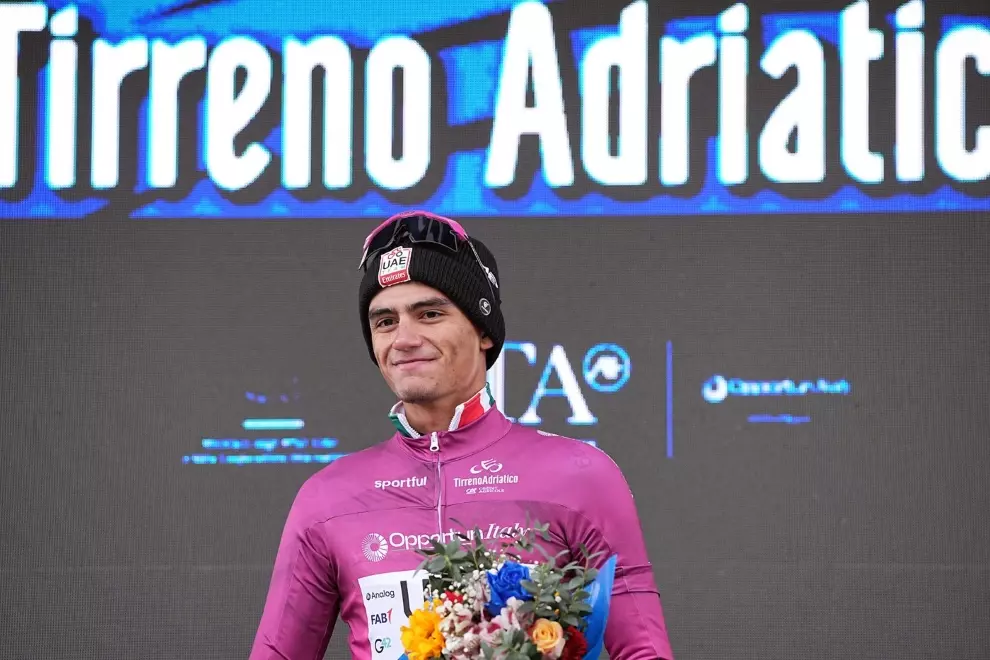
In this case, however, UAE is hedging its bets because of the fractured rib Almeida sustained on stage 7 of the Tour, which caused him to abandon the race two stages later. He may not be fully fit yet. If he’s at his best, he will be a formidable opponent. He has nine victories this year, including GC wins in the Tour de Suisse, Tour de Romandie and Itzulia Basque Country. Ayuso has five wins, including the GC in Tirreno-Adriatico. He’s an excellent climber, but not yet on the level of Vingegaard or Almeida. The two UAE riders have already raced the Vuelta twice together, in 2022 and 2023, with Ayuso’s third in the earlier race, nearly 5 minutes behind the winner Remco Evenepoel, their only podium finish.
The also-rans
With Richard Carapaz (EF Education–EasyPost) not entered in the race because of a recent illness, I don’t see anyone challenging the above trio in the GC. Ben O’Connor (Jayco AlUla), Egan Bernal (INEOS Grenadiers) and Jai Hindley (Red Bull–BORA–hansgrohe) could win a stage or two and/or end up of the final podium. Bernal and Hindley have won Grand Tours, but the Colombian has not yet recaptured his pre-crash form that led him to wins in the Tour de France (2019) and Giro d’Italia. O’Connor finished second in last year’s Vuelta, to Roglič, and is coming into this year’s race with only one victory for the season, as he did last year. He then finished second in the World Championships, so he seems to save his best for the end of the year.
Hindley, who won the Giro in 2022, crashed out of this year’s Giro, fracturing a vertebra, and has had only one race since, the Vuelta a Burgos, in which he finished 25th, so his form is questionable. But his 21-year-old teammate Giulio Pellizzari is an interesting rider. He finished sixth in this year’s Giro and fourth in the Vuelta a Burgos, well ahead of Bernal and Hindley. He will be a fascinating watch throughout the race.
And the Škoda Green Jersey?
And then there is Q36.5’s Tom Pidcock. This is the pro team’s first time at the Vuelta, as it needs a wild card invite to participate in Grand Tours. Pidcock rode in this year’s Giro and finished 16th. He is one of the best cyclists in this race, but he is not a climber, or hasn’t been so far. “The course this year is very diverse but still typical of the Vuelta, with its many uphill finishes. There are plenty of stages with profiles that could suit a rider like me,” he was quoted as saying on the team’s website. “We learned from the Giro and had more time for thorough preparation this time… I’m curious to see what I can do in the general classification.”
Unfortunately for Pidcock, the stages that suit him do not include the big mountain stages, where he will probably lose substantial time to Vingegaard et al. But there are plenty of hilly and medium mountain stages where he should be competitive. He may even have a chance to win the Škoda Green Jersey since many of the race’s flat stages have uphill finishes that do not favour sprinters. In addition, only two stages, the first and the last, have been classified as bunch sprints, which offer a maximum of 50 points to the winner. But Pidcock will have to contend with Lidl-Trek’s Mads Pedersen, who is having a monster of a year, with 13 victories and four green jersey wins, including in the Giro, and with Filippo Gana (INEOS Grenadiers), who is always a threat to win something.