Kalin Dam isn’t famous for its hospitality. It’s Bulgaria’s most brutal climb: 15.1 kilometres long, 1,717 meters of elevation gain, and not a single meter of descent. The friendly 11.3% average gradient is a cruel joke, as the slope rarely drops below 14% in the second half. The whole ordeal ends at 2,546 meters above sea level, roughly four hours after you start at just 860. Unsurprisingly, PJAMM Cycling ranks it as the sixth hardest climb in Europe. I underestimated it completely. In my head, it was just another long effort with three short stops, calm pacing, and a scenic day in the mountains. Reality was different. But let’s start from the very bottom.
The route
The climb to Kalin Dam begins in Pastra, a quiet village just a few kilometres from the Rila Monastery, Bulgaria’s most famous UNESCO World Heritage site. It’s where pilgrims come to find God, hikers come to find peace, and cyclists come to question both. From the first pedal stroke, the road wastes no time establishing its personality. The gradient opens at a steady 7–8%, which sounds manageable until the first kilometre ends and the slope shoots up to 13–14%. That’s when you realise this isn’t a climb that builds suspense. It gets in your face, almost literally, from the very start.
The first half is relatively kind, averaging around 10%, with short spikes flirting with 15%. It’s the sort of gradient that lets you believe you’re handling it… right until the hydroelectric station appears around the seventh kilometre. That’s where things change. The trees thin out, the road narrows, and the mountain stops pretending to care about your well-being. From there, the average gradient jumps to 14.6%, and the real pain begins. A short 10–15% stretch serves as the warm-up for a two-kilometre section that refuses to drop below 17% for more than a few meters. The steepest parts hit 32%, which legally can’t be called a road in Bulgaria.
Then come the twelve switchbacks: 2.5 kilometres, averaging 15%. They look spectacular on a map, less so when you’re living through them. The final stretch tilts down to a “relaxing” 12.5%, which, by that point, genuinely feels like a descent. The road surface is mostly concrete panels, though in some sections the panels are more theoretical than physical. The first 9 kilometres are shaded by trees, sparing you from the sun but not the gradient. Once you pass 1,900 meters above sea level, the forest disappears, the air cools sharply, and the sunlight feels more like a survival tool than a problem.
Near the top, the road briefly flattens. One single kilometre of mercy, where the 4% gradient tricks you into thinking you can coast it. But this joy is short-lived. The gradient quickly spikes back to double digits before reaching the final destination.
In short, this is one ruthless climb, which, if you manage to climb without stopping, you’re a world-class rider.
The plan
A world-class rider I’m not. And I don’t pretend to be. I’m just a slightly overweight enthusiast with delusions of grandeur and a reasonable sense of what’s possible. Usually. This time, however, I underestimated the climb spectacularly. My plan was simple: three ten-minute stops, an average speed of 5 kph (which for me would mean between 150 and 250 Watts, depending on the gradient, and a total time of three and a half hours. It sounded reasonable on paper, which is precisely where it should have stayed.
The problem was that I’d spent the previous week on what could generously be described as a forced diet. After discovering, in a rather unpleasant way, that I had developed an allergy to shellfish (as advised by the doctor), I eliminated almost everything from my meals except for fruit, yoghurt, bread, and feta cheese. In seven days, I lost three kilograms and obviously, most of my common sense.
I brought no supplements, since most of them contained ingredients on my “do not die” list. So I started the climb with three cheese sandwiches, a handful of dates, a few dried plums, and one pack of magnesium that I carried, hoping I wouldn’t have to drink it. My body was already running on fumes before the ride began. Still, the start felt fine. We were fresh, steady, and even a little optimistic.
The first 7 km
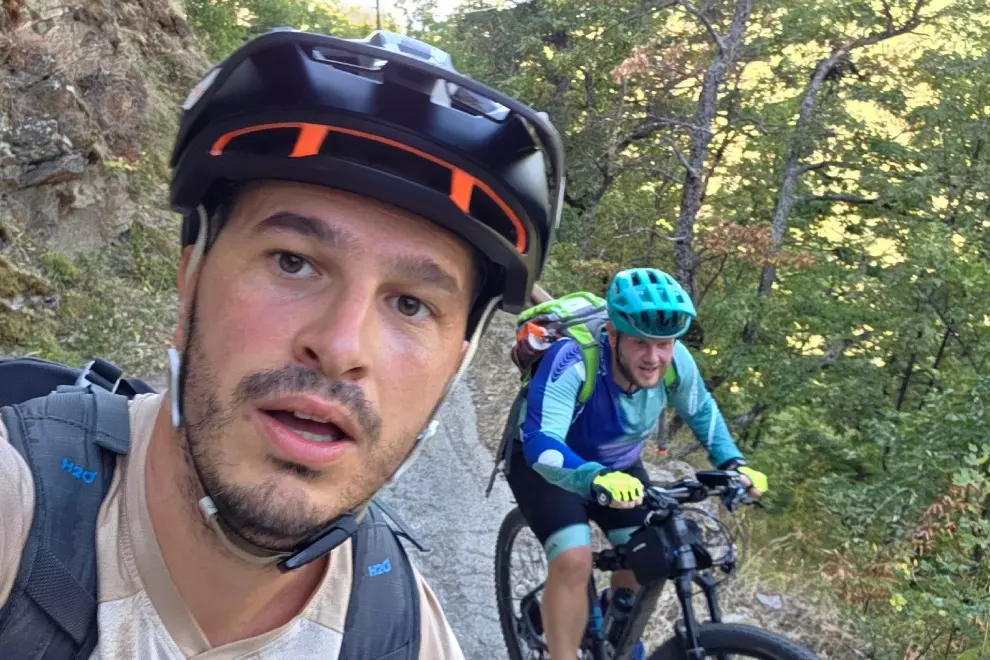
We covered the first kilometre quickly. The legs were fresh, the air was cool, and the gradient sat politely around 7–8%. The concrete surface was in good shape, and for a brief moment, it almost felt easy. That illusion disappeared around the third kilometre, when the slope spiked to 16% without warning. Still, at that stage, those steep bursts felt more like novelties than threats.
We kept a steady rhythm, chatting occasionally, pretending this was still fun. The views began to open up between the trees, and every short stop felt earned rather than necessary. By the fifth kilometre, we had made good time, under an hour, and stopped for a minute to take in the panorama that unfolded below, just a couple of hundred meters after the one-hour mark.
If you ever decide to attempt this climb, the perfect rest spot is at 5.3 kilometres. The view is worth it, and right after that comes one of the rare stretches that could be described as flat, sitting at a merciful 5 per cent. It is the one place where you can catch your breath, drink some water without sounding like Darth Vader, and briefly believe you will make it without much trouble. They are not, but you will find that soon enough. We reached the hydroelectric dam, the official halfway point, in 1 hour and 41 minutes. It felt like progress. Spirits were high, legs still responding, time well within plan. Unfortunately, that was the easy part.
After the hydroelectric dam
The first 200 meters after the hydroelectric dam were merely a preview of what was to come. The road ahead looked less like a route for vehicles and more like an ambitious wall experiment. Each pedal stroke lifted the front wheel just enough to remind me that this was no longer about fitness. It was about the unforgiving nature of gravity.
Then, almost mockingly, the gradient flattened to around 4%. It was enough to spark false hope. Two hundred meters of a nearly 20% incline, followed by a brief 4% recovery, felt survivable. But that small stretch was the last kindness the mountain offered. What came next was 2 full kilometres where the gradient never dropped below 17%. At one point, it reached about 35% for 50 meters, which sounds like an exaggeration until you try it yourself. Calling it brutal would be polite.
We stopped about 1.2 km into this madness at a viewpoint that overlooked the valley and the dam below. From up there, the hydroelectric station looked like a toy, sitting about 1.5 km behind us. The only comfort came from watching another group of cyclists arrive at the guard hut. They were about to learn what despair looks like at altitude. We planned to rest longer, but the local insect population had other ideas. A swarm of bugs had claimed the shrinking patch of shade as their personal buffet, and we were clearly on the menu. Rest or not, we had to move.
At the 9th kilometre, we reached the first reliable water source. It felt like an oasis. We took a longer 10-minute break and had a small meal. I ate one of my three cheese sandwiches, a few dates, and one dried plum bar. By then, I had burned through roughly 1,700 calories and replaced less than 500. Still, it was food, and for a short moment it helped. The cramps started soon after. We pushed on, and barely a kilometre later, the infamous 12 switchbacks came into view.
The 12 switchbacks and the 2 cramps
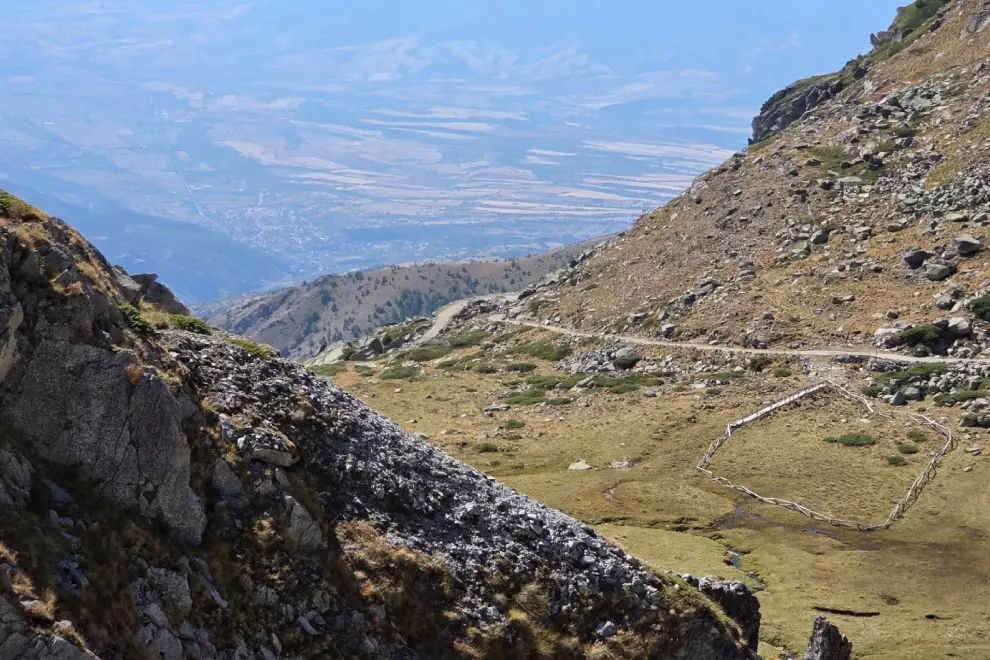
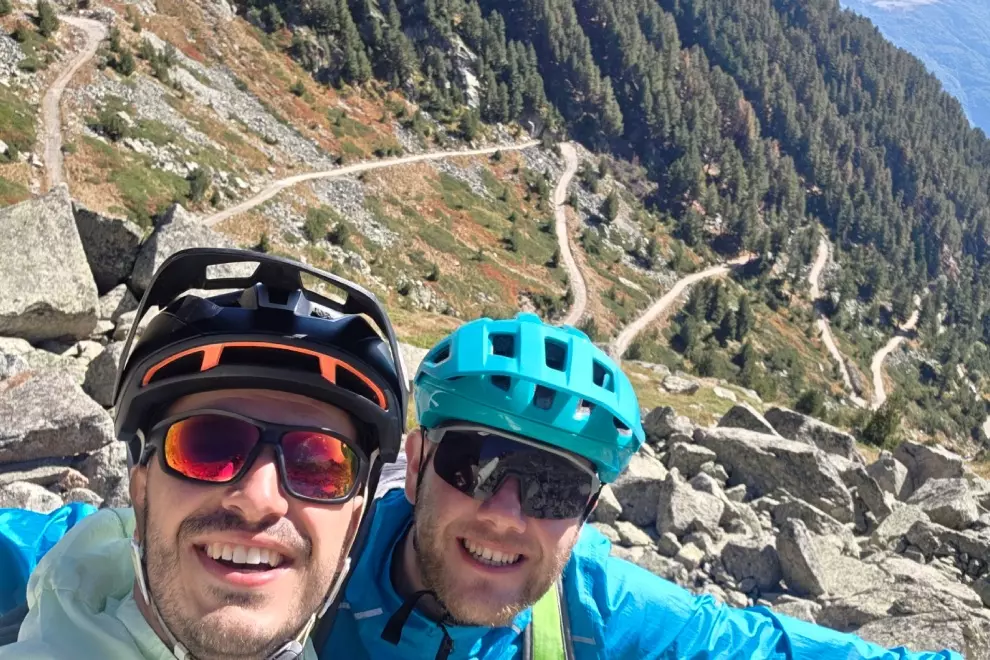
The 12 switchbacks of Kalin Dam are infamous. They twist up the bare mountain for 2.5 km, averaging 15%, a stretch so steep it feels like it is trying to fold the Earth back on itself. Whoever designed this road must have looked at normal gradients and thought, “Charming, but let’s make it vertical.” It ends with a panoramic view that almost justifies the pain. You can see all 12 bends curling below, the vast Struma Valley spilling into the horizon, and two distant mountain ranges framing the chaos. The starting point sits far below, more than 1.5 vertical kilometres beneath your wheels. In just 12 km, you climb over 1,500 meters of pure, unapologetic brutality.
We stopped at the third switchback to refill our water bottles. This was the last guaranteed source before the summit. There was another small spring higher up, but after three months without rain, it was as dry as my optimism. That is when the real trouble began. My right quad seized up without warning, and I gulped down my magnesium shot, hoping it would work before the other leg joined in. I told my mate to ride on, unsure if I would make it to the top.
After a few minutes of cursing and stretching, I got back on the bike. The next few turns were survival mode. I reached the 11th switchback and aimed for the 12th, where I planned to stop for food. Both quads cramped at once, and I went down like a puppet whose strings had been cut. I crawled to the edge of the road and sat on the cliff, legs hanging lifeless over the valley. I ate my second cheese sandwich and waited. Then I ate 6 dates, 2 dried plum bars, and downed 2 bidons of water with an electrolyte tablet. After 25 minutes, the pain had subsided enough for me to stand again. I pushed the bike the next 100 meters to the final viewpoint and stayed there for another five minutes, pretending to admire the scenery while trying to get my legs back. Then it was time to finish what I started.
The next section hit back immediately. A 25% wall for about 100 meters forced me off the bike again. I pushed it, step by step. The last kilometre before the dam was merciful by comparison, sitting between 10 and 12%, with short spikes to 18%. A few lazy cows wandered across the road, completely unimpressed by the human suffering taking place in front of them.
When the gradient finally eased, I reached the flat stretch above the reservoir. The road softened for a few hundred meters, then threw one last ramp into double digits before surrendering to the top. It took me 4 hours and 40 minutes to finish the climb. An hour longer than planned, but still… I was at the top.
My mate had arrived about 30 minutes earlier. He said he saw me pushing the bike on the 25% wall and was certain I would still finish. He only expected me to be a bit later. We talked, shared food, compared cramps, and took photos of the view that had tried so hard to kill us. I shared my last sandwich with a small shepherd dog that decided we were its new friends. We spent about 40 minutes at the summit, not celebrating, just existing, and after such a climb, that’s good enough.
The way back
The descent should have been a reward. It wasn’t. It took us about 40 minutes to get back down, which sounds fast until you remember how steep this climb is. The gradients were so extreme that we had to stop twice just to let the brake disks cool off. Smoke from hot rotors in the thin mountain air has a very specific smell.
The road’s blind corners kept us cautious. Every turn could hide a cyclist, a motorbike or a heavily loaded off-road vehicle grinding its way up toward its own bad decisions. There was no time to “woosh” down, only to survive gravity with as little disk damage as possible. Still, descending through the same scenery felt surreal. The views that looked endless on the way up now passed in seconds. The dam, the forest, the endless wall of concrete – all blurred into one long slide back to our car.
By the time we reached the village, the legs were empty, the brakes smoking, and the grins genuine. Kalin Dam doesn’t offer trophies or medals. It gives you sore muscles, sunburned memories, and a quiet, smug sense of having done something truly stupid… and great… mostly great, and that’s why we do it.