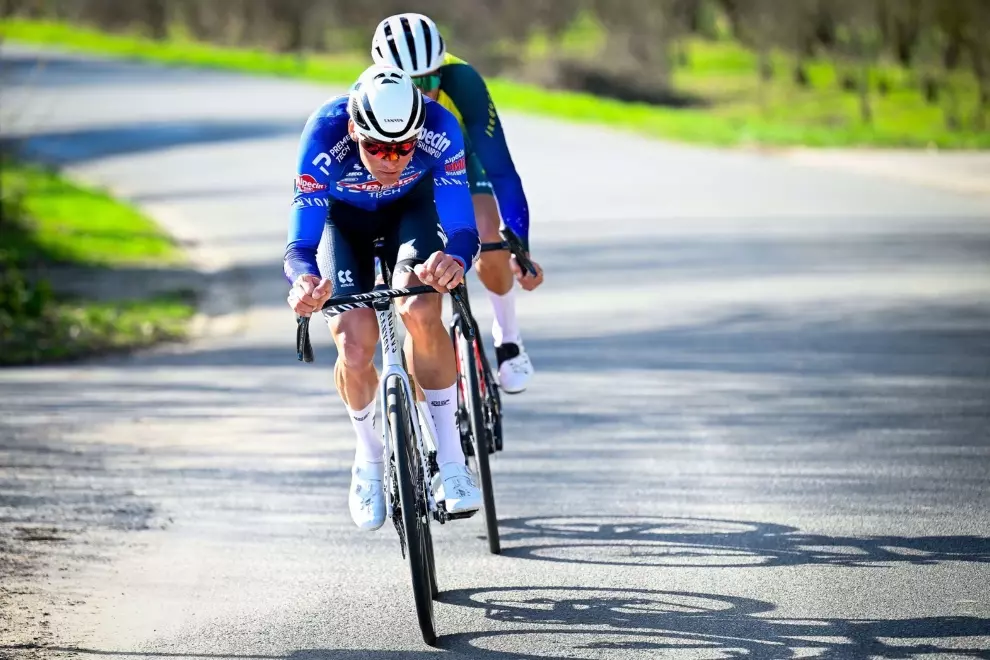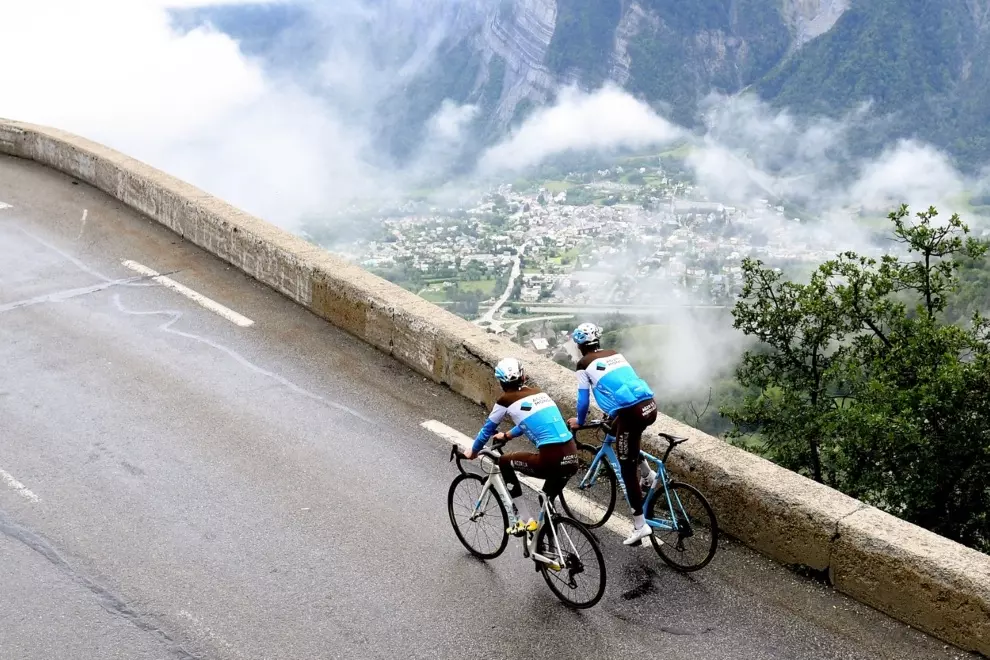
On Sunday, July 19, riders participating in the 34th edition of L’Étape du Tour de France will tackle nothing less than the race’s queen stage — Stage 20 — 171 km from Bourg-d’Oisans to the top of Alpe d’Huez. The more than 5,400 m of altitude gained includes such legendary climbs as the Col de la Croix de Fer (24 km @ 5.2%), the Col du Télégraphe (11.9 km @ 7.1%), and the Col du Galibier (17.7 km @ 6.9%). However, Alpe d’Huez will be climbed from a different side than usual and not from its foot. Rather, it will be tackled after the Col de Sarenne (12.9 km @ 7.3%) and consists of a relatively small bump in the road (3.8 km @ 6.1%). But the view from the top will be the same.
Some 16,000 riders are expected to participate — quite an increase over the 1,700 who took part in the first edition on July 11, 1993. That L’Étape went from Tarbes to Pau in the Pyrenees, covered 208 kilometers, and included an ascent of the Col du Tourmalet. Interestingly, the winner of that first edition, Christophe Rinero, went on to become a professional rider and finished fourth in the 1998 Tour de France.
In 2011 and 2012, the event was a two-day affair. The 2017 L’Étape was won by Norwegian rider Jonas Abrahamsen (yes, the Jonas Abrahamsen who now rides for the newly promoted all-Scandinavian Uno-X Mobility). In fact, over the years, a number of future and past professional riders have participated, including Thierry Bourguignon (1995), Greg LeMond and Éric Boyer (2000), Miguel Induráin and Abraham Olano (2003), and Victor Lafay (Decathlon AG2R La Mondiale), who won the 2018 L’Étape and has since won a stage of both the Tour and the Giro d’Italia.
It will be a difficult slog, especially — as has often been the case — if it is hot. It is therefore imperative that you come to the event in the best form of your life. To that end, you will have to present a sports license or a medical certificate stating that there are no contraindications to the practice of competitive cycling, or a “Module Santé” certificate, to be uploaded on the Timeto platform. For more specific regulations, see here.
While there is no time limit for finishing, a “time vehicle” will follow the trailing riders, who must drop out of the contest if it overtakes them. If you’re an amateur cyclist with ambitions to move up, this event is a must — not only to measure how you are doing compared to other riders, but also for the sheer experience of racing in a Tour de France stage. Registration for the event begins on Monday, November 3, at 2 p.m. French time here.
For those riders who are interested in participating in such an event but can’t make it to France for one reason or another, the Amaury Sport Organization (A.S.O.), which organizes L’Étape du Tour de France (and, of course, the Tour de France), has agreements with local partner organizations such as Kolo pro život, z.s. in the Czech Republic to hold similar races on local circuits. Go HERE to find out about the more than 30 races in the L’Étape series of events. For example, L’Étape Greece takes place on April 4 in Sparta, while L’Étape Serra Negra will be held on June 27 in Serra Negra, Brazil.
In addition, for the second year in a row, there will also be an edition of L’Étape du Tour de France Femmes avec Zwift, which will be held on August 6 and will consist of a 120 km course from Vaison-la-Romaine to the summit of Mont Ventoux (15.7 km @ 8.8%), comprising about 3,000 meters of altitude gained. For more information, read here.