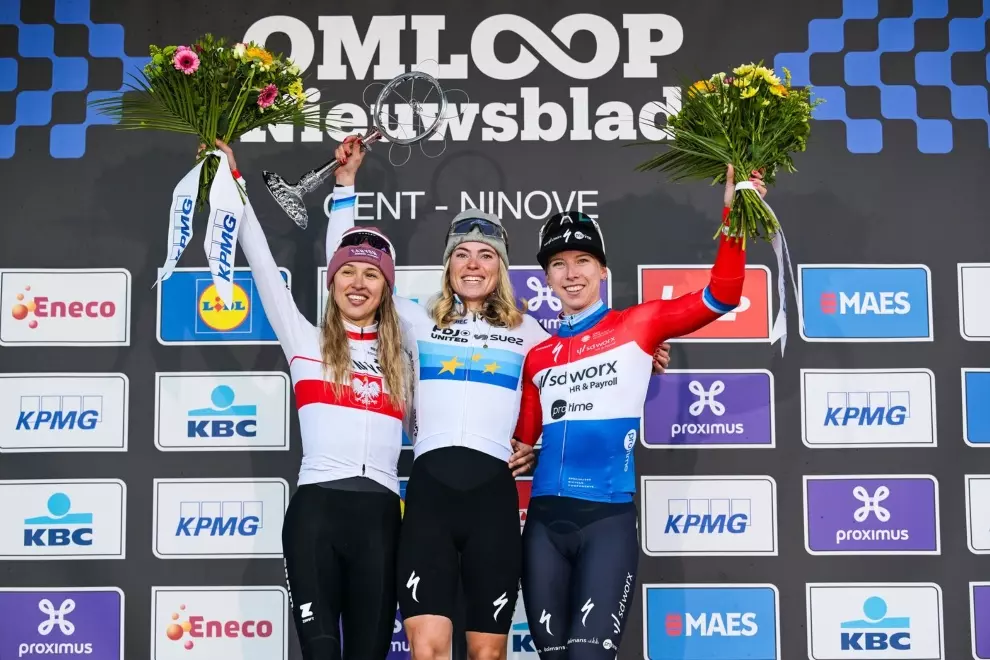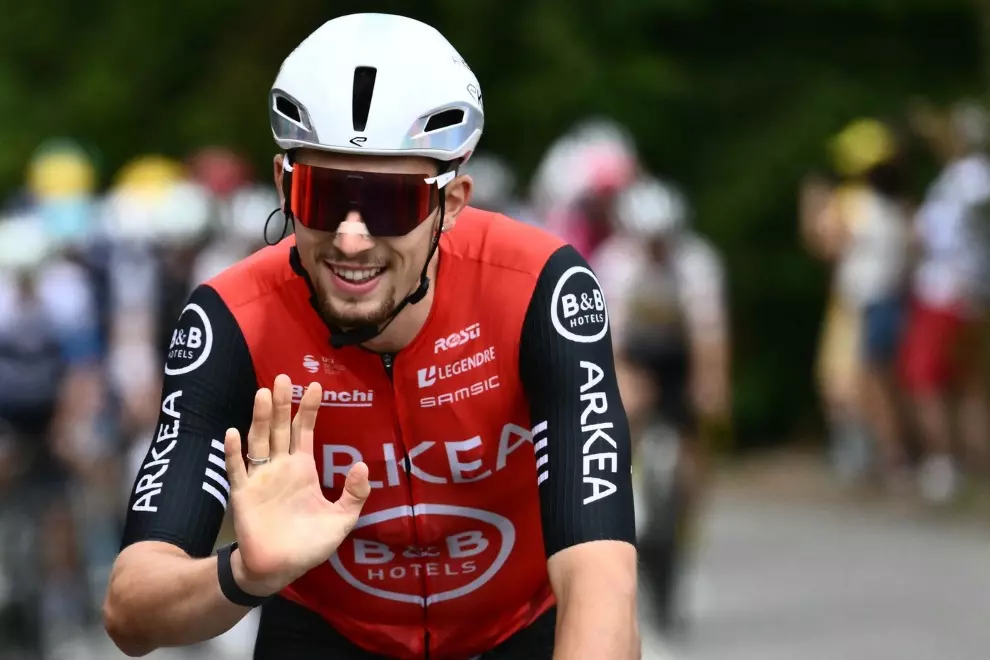
Admittedly, things aren’t all rosy in the land of Camembert cheese and Château Margaux wine: the French women’s team FDJ-Suez, which supplanted SD Worx–Protime as the most successful team of the year, thanks largely to its leader Demi Vollering, has announced that it is curtailing its racing program by 5 to 10% because of a shortage of funding; and, more seriously, the French team Arkéa–B&B Hotels will cease to exist at the end of the year because it could not find a sponsor.
A French winner for INEOS
That is a mixed blessing for the 24-year-old Arkéa rider Kévin Vauquelin, who has raced so impressively for his cash-starved squad that he was picked up by the generously funded INEOS Grenadiers. Last year, Vauquelin recorded his team’s first, and last, Grand Tour stage win when he was victorious in stage 2 of the Tour de France. This year he finished seventh in the Tour and in the Tour de Suisse; he has also twice finished second (2024 and ‘25) in the classic La Flèche Wallonne.
Given the improved training facilities, equipment and teammates he is certain to find at INEOS, he will be a rider to watch in one-day races and Grand Tour stages. He will have to improve by leaps and bounds, however, to end his country’s run of Grand Tour GC futility, which dates back to 1995, when Laurent Jalabert won the Vuelta a España, the last French rider to win a Grand Tour. As is well known, France’s drought of Tour de France wins dates back another 10 years.
Will Seixas et al. end the drought?
The country’s hopes of ending one or both of these losing streaks may rest on the shoulders of 19-year-old Paul Seixas (Decathlon CMA CGM), who won this year’s Tour de l’Avenir, a race that has in the past signaled the arrival of such future Tour de France champions as Joop Zoetemelk, Greg LeMond, Miguel Induráin, Laurent Fignon, Egan Bernal, and Tadej Pogačar. This year he also placed third in the European Championship Road Race, seventh in Il Lombardia and eighth in the Critérium du Dauphiné, becoming at age 18 the youngest rider ever to achieve a top 10 finish in a UCI WorldTour stage race (he turned 19 on September 24).
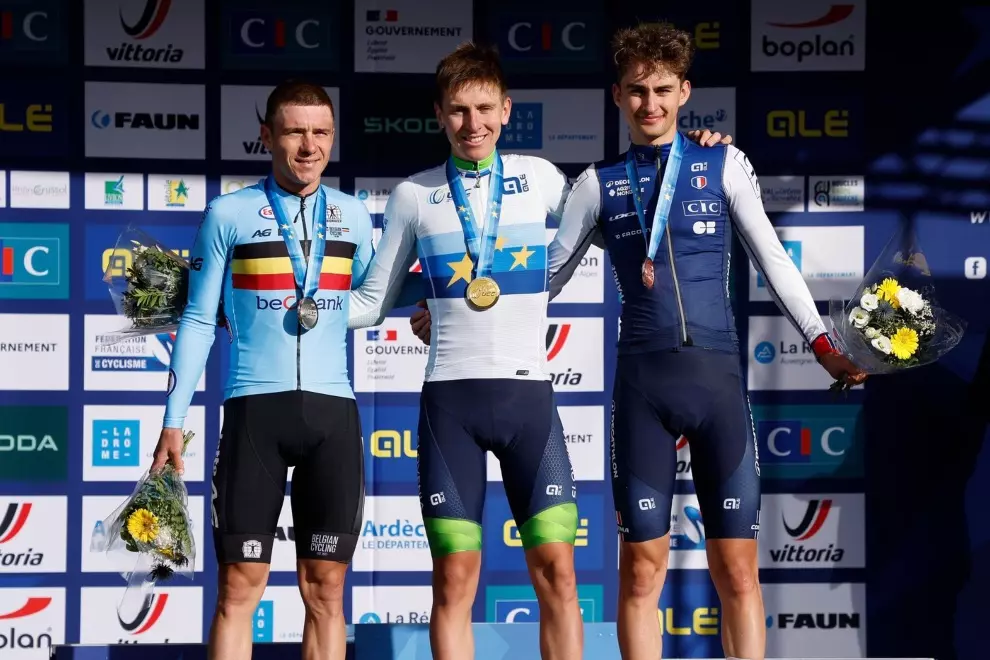
Riding for big-spending Decathlon, he looks to have the support and the potential to race for Tour de France glory once the all-conquering Pogačar retires. But he doesn’t want to wait that long. “The goal is not to beat him when he’s on the decline, but when he is at his best level,” the very ambitious Seixas said. That is exactly the kind of confidence and audaciousness it takes to be a Grand Tour champion. Of course, you also need the legs.
Romain Grégoire announced himself as a potential future champion when he won the U23 Liège–Bastogne–Liège, the 2021 European junior road race and time trial championships, and a stage of the under-23 Giro d’Italia. This year, aged 22, he won the Tour of Britain, beating Remco Evenpoel in the GC by 2 seconds, the Faun-Ardèche Classic, a stage of the Tour de Suisse, in which he finished fourth. The team has a GC rider in David Gaudu, but he is 29 and has not been a GC threat for some years. It’s possible, depending on Grégoire’s progress, that Groupama may look to Grégoire to fill that role.
Another potential French Grand Tour winner is 22-year-old Lenny Martinez. That’s what Bahrain-Victorious thought when they signed him from Groupama-FDJ at the beginning of this year. It was certainly a good move for Martinez, who improved every phase of his skillset in 2025. He won the Japan Cup on the last day of the season, finished second in the Tour de Romandie and won a stage of the Critérium du Dauphiné.
However, though he is clearly a better rider than he was a year ago, questions remain about his race management. For example, on the final climb of the Giro dell’Emilia, when different riders attacked 2km from the finish, he followed every single attack and then didn’t have the legs to ride with Tom Pidcock (Q36.5) and Isaac del Toro (UAE Team Emirates–XRG) in the decisive move of the race. That Martinez nevertheless finished third illustrated his prodigious resources; he now needs to be better at using them.
A French sprinter looking for green
The French have also not had many Grand Tour green jersey winners. The last one was Arnaud Démare in 2022 (the Giro). Before that, there was Nacer Bouhanni (Giro) in 2014 and before that the great Laurent Jalabert, who won a total of seven, including points classification wins in all three Grand Tours, the last one in 1999. They may now have a future multiple green jersey winner in Paul Magnier. Magnier is only 21 years old and in 2025 he won 19 races. If he is not mentioned in the same breath as Pogačar, who won 20, it is because most of the victories came in lower-level races, such as the Tour of Guangxi, in which he won five of the six stages and the green jersey.
He also won the green jersey in the CRO Race and the Tour of Slovakia, won a stage in the Tour of Poland, came in third in a stage of the Giro, won three minor one-day races and finished second in the Omloop Nieuwsblad, outsprinting Jasper Philipsen for that podium place. The kid obviously has a huge upside and riding on the sprinter-friendly Soudal Quick-Step – whose primary sprinter, Tim Merlier, will turn 33 at the end of the month – he should have lots of chances to stretch his legs. There is currently an unprecedented group of very talented sprinters in the peloton, with Philipsen, Joathan Milan (Lidl-Trek), and Olav Kooij (Decathlon CMA CGM in 2026), to name only three. Magnier should find his rightful place among them.
I know that there have been promising French riders before that did not live up to the hype that accompanied them into the peloton. But this group feels different. They look unbothered by the expectations, and in some cases even happily add to them. That’s a promising sign.