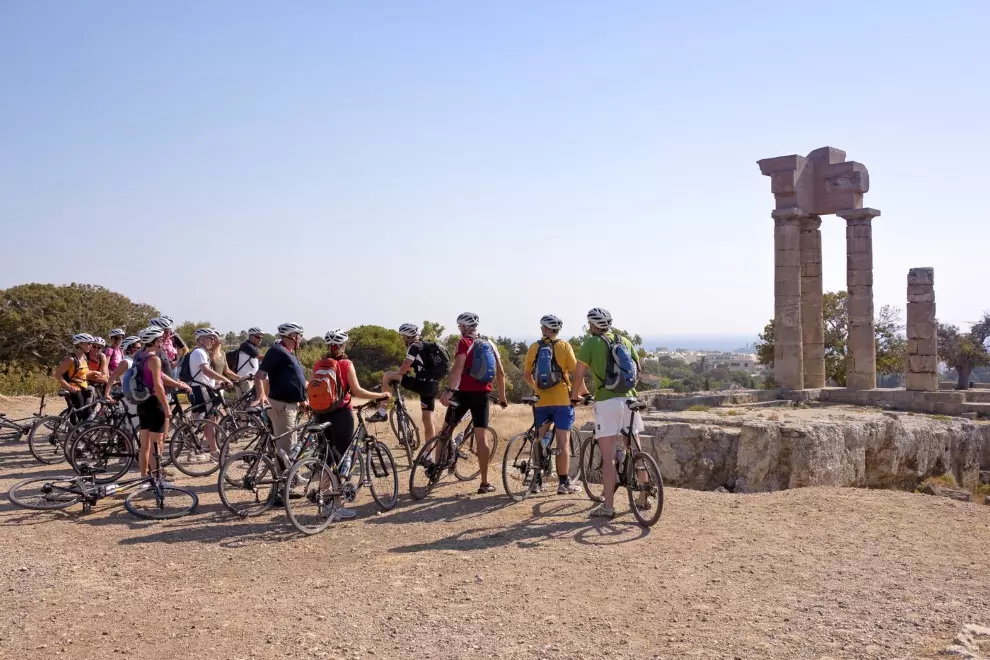
But there’s one small problem, and his name is Helios — the ancient Greek god of the sun. When they call Rhodes the island of Helios, they’re not kidding. The guy’s got no chill. By mid-September, afternoons were so hot it felt like riding inside an oven, but without any moussaka to make you company. Standing outside is difficult; pedalling… let’s say Hercules might have failed, if it were one of the 12 challenges. Still, it’s hard to stay mad at the sun when it’s also your wingman. With enough sunscreen to qualify as a separate piece of luggage, you can still make it work.
So, is it worth spending your hard-earned vacation days pedalling across this sun-baked paradise? The short answer? Absolutely. The long answer? Well, there’s a bit more to it. So, if you plan to ride with Helios, listen closely.
How to choose a rental
Let’s be honest – very few people are going to drag their personal bike onto a flight to Rhodes. And frankly, you don’t have to. Sure, the local rentals won’t hand you a 23,000-euro marvel of engineering, but that’s hardly a reason to subject yourself to the emotional and financial trauma of flying with your bike.
The local bike shops are good enough, and on Rhodes, good enough is exactly what you need. Most offer a selection of lower- to mid-range road and MTB bikes that are properly maintained and ready to roll. The key is knowing where to rent. Go for a dedicated bike rental, not one of those all-purpose “we rent everything from helmets to helicopters” outfits. The latter usually means you’ll spend half your vacation adjusting gears, tightening bolts, and cursing whoever last touched that derailleur. If you’re staying outside Rhodes Town, check that your rental shop has a nearby office or offers delivery to your hotel. I rented an MTB for a day and a road bike for another – both clean, tuned, and surprisingly well-prepared.
A few essentials: bring your own pedals and shoes. The flat pedals provided looked and felt like they were designed for medieval torture, not cycling. Listen carefully to the shop’s instructions, and if you already have routes in mind, ask for advice. They’ll tell you where it’s dangerous, where it’s impossible, and where it’s actually worth pedalling. Just don’t expect them to read your mind. Be upfront about your fitness, your experience, and what kind of suffering you consider “fun”. They’ll tailor the recommendations accordingly – or at least warn you before you accidentally sign up for a 1,000-meter climb under a 40-degree sun.
Where to ride
If you love both road and mountain biking, Rhodes won’t disappoint. The island offers enough variety to make any type of rider happy… or at least satisfyingly exhausted.
Road
The west side of the island is a road cyclist’s dream: quiet, well-maintained mountain roads that wind through villages and hills with views that make you forget how much you’re suffering. The further south you go, the higher and steeper the mountains get. My only mistake was sticking strictly to the tarmac. If you bring or rent a gravel bike, you’ll get a far richer experience. Rhodes is full of unpaved roads cutting through the mountains, connecting tiny settlements and leading to some truly absurdly beautiful viewpoints.
You can even tackle Mount Attavyros, the island’s highest peak at 1,215 meters above sea level, if you’re into that sort of masochism. Be warned: the climbs can hit over 20%, and the heat will make you wonder if this is still Greece or the surface of Mercury. I personally decided against testing how well I’d roast at altitude and instead went for a gorgeous loop around the Gadoura Dam, the island’s largest water reservoir. It’s a 60-kilometre route from Lindos, with short, punchy climbs and fast descents that make you feel briefly athletic before the next hill humbles you again. The scenery? Unreal. Blue water, green hills, and the kind of silence that makes you think you’ve accidentally pedalled into a Windows wallpaper.
MTB
My mountain bike ride was a whole different kind of fun, and maybe a bit more my speed. We were staying in Malona, essentially the orange capital of Rhodes, surrounded by endless orange and olive groves. Riding between them felt surreal, like I’d accidentally joined a Mediterranean version of The Shire. A word of warning, though: the goats. They appear from everywhere – behind trees, from slopes, possibly from another dimension. They’re harmless but terrifyingly unpredictable, so keep your eyes open unless you want a surprise headbutt mid-descent.
The south-eastern side of the island is packed with trails any MTB rider would love. I rode up toward the Seven Springs and on to a small mountain lake near Laerma, then descended through a dry riverbed. It was mostly a light slope with a few technical bits – just enough to keep things interesting without needing medical insurance paperwork. I briefly considered climbing the mountain near Lindos (I think it’s called Zata or something equally menacing), but thankfully, the rental guy talked me out of it. No trees, giant loose rocks, and the kind of terrain that even goats avoid. OK, not goats. Those are like parasites there. They are literally everywhere. The only reward would’ve been a view of Lindos from above, and most likely a heat stroke to remember it by.
There are plenty of other routes worth exploring, depending on where you’re staying. The area near the Valley of the Butterflies has some fantastic trails, though you can’t actually ride into the valley itself. It’s for butterflies, not overconfident MTB riders. So, yes, Rhodes offers plenty for both road and mountain bike enthusiasts, as long as you pick your routes wisely and respect the limits of both your bike and your skin’s melting point.
Where not to ride
As tempting as it might be to explore every inch of the island, there are places where riding a bike in Rhodes goes from “adventurous” to “please don’t”.
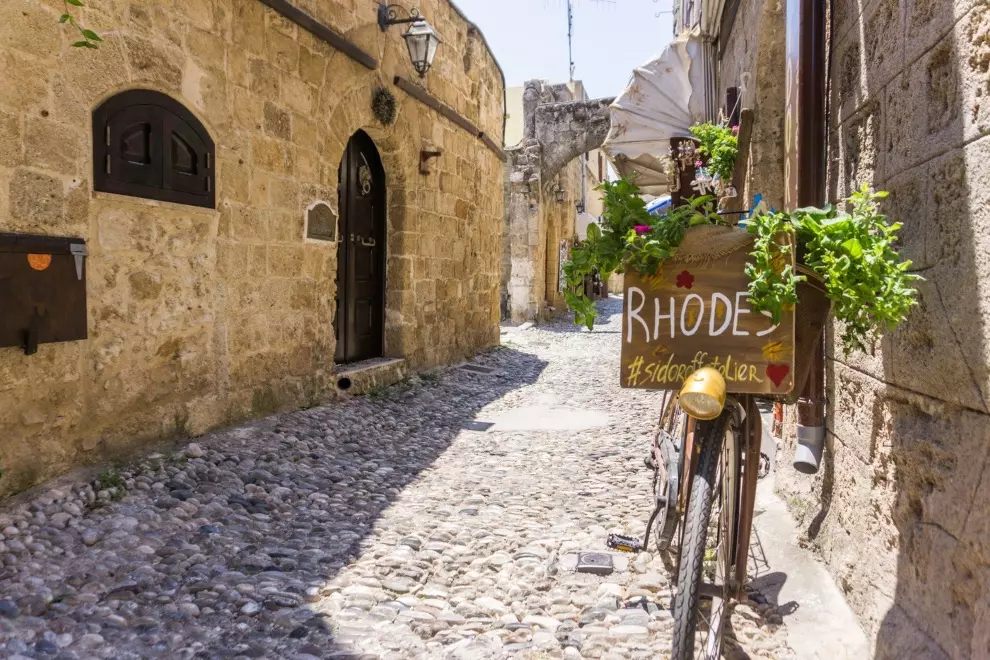
Let’s start with Rhodes Town, which dominates the north-eastern corner of the island. The medieval city is a UNESCO treasure – and absolutely off-limits for cycling. Not just because it’s forbidden, but because it’s physically impossible. The narrow streets are packed with tourists, selfie sticks, and enough souvenir shops to put a dent in the Greek economy. You’ll spend more time apologising than pedalling. Do yourself a favour: leave the bike at the gate and enjoy the old fortress on foot.
The rest of Rhodes Town isn’t much better. The streets are overcrowded, the traffic chaotic, and the drivers distracted by rental-car GPS screens in languages they don’t understand. Add in a few steep climbs, and you’ll become a mobile traffic jam faster than you can say “pothole”. Unless you’re sleeping there, skip the city altogether.
The main Rhodes–Lindos road is another no-go. Yes, it’s the most direct route along the east coast, but it’s also a parade of buses, scooters, and rental cars. While the drivers are generally respectful, the constant noise and exhaust fumes will drain any joy you hoped to find. Take the smaller coastal roads instead. They’re quieter, more scenic, and if you overheat, you can always dive into the sea before the sun finishes you off.
Avoid the airport road too – it’s perpetually busy, especially when flights arrive. And while we’re on the subject, steer clear of the road to the Valley of the Butterflies. It’s beautiful, but it’s also narrow, winding, and crowded. If you absolutely must visit with your bike, use an MTB or gravel setup – something that can handle the detours you’ll need to take to stay alive.
And finally, whatever you do, don’t attempt to ride into the Lindos town centre. The streets are so narrow that even the tourists are jammed shoulder to shoulder. There’s no traffic, just human gridlock. Take the hint, park your bike outside, and join the crowd on foot.
Everywhere else? The island is yours. Once you get past the hot zones of humanity, Rhodes turns into a cyclist’s playground – endless blue sea on one side, mountains on the other, and only the occasional goat plotting a surprise attack.
A few things to note
Cycling in Rhodes is great, but it takes its toll. The island rewards effort, not recklessness. The best approach is simple: start early, ride in the morning, and spend the lunch hours somewhere with air conditioning or at least a tree that doesn’t look like it’s considering spontaneous combustion.
The heat is no joke. In mid-September, it hovered around 30°C with humidity above 85%. You don’t sweat, you’re just as fresh as an overused mop in a bathhouse. Helios obviously doesn’t know the meaning of the word moderation, so make sure you’re the bigger person and just let him spray his rays in abundance. You will enjoy them eventually on the beach.
On the note of heat, bring plenty of water and plan your route so you pass through a town or village every hour or so to refill. You won’t feel thirsty because of the humidity, but that’s just your body quietly filing a resignation letter. Drink at least one bottle per hour and bring electrolytes. You’ll need them if you want to finish the day looking remotely human. The distances on Rhodes aren’t long, but they’re deceptive. Short routes often hide steep climbs that appear out of nowhere, and by the time you notice, you’re already halfway up and negotiating with whatever gods are still speaking to you.
And then there are the goats. Did I forget to mention them? Yeah, these charming creatures are everywhere. Like the Illuminati, but less secretive. Most are harmless, but if you startle a male or look too confident, they might decide you need humbling. Trust me, you don’t win that fight. Otherwise, you’re good to go. Just hydrate, respect the sun, and accept that Helios is always watching… mostly to see how long it takes before you beg for shade.
Was it worth riding with Helios?
Absolutely. Riding in Rhodes is an experience you won’t forget – partially because of the scenery, and partly because Helios will personally brand the memory into your skin. Yes, it’s hot, steep, and occasionally feels like a slow-motion battle against dehydration and gravity. But it’s also beautiful beyond reason. The sea seems to follow you wherever you ride, the mountain roads twist through landscapes that look stolen from mythology, and even the quietest villages greet you like you’ve just completed a heroic quest.
Rhodes isn’t the easiest place to ride, but that’s exactly what makes it worth it. You earn every view, every descent, and every coffee break in the shade. The climbs are steep, the heat is brutal, but the reward is simple: you get to say you rode with the Sun God himself and lived to tell the story.
So yes, it’s worth it. Just bring sunscreen, patience, and a goat repellent, if there is such a thing. Because on Rhodes, the line between suffering and joy is as thin as your last layer of SPF 50.