A tandem makes them part of the suffering, which is far more convincing than screenshots of your average speed. And it works because a tandem isn’t just a bike. It’s a shared experience, a way to bond over something you love without asking your partner, friend or family member to become a diehard cyclist overnight. It gives them the taste without threatening your precious solo time with your bike. But before you leap at the idea like a toddler given permission to eat ice cream until they explode, there are a few things to consider before strapping an unsuspecting non-rider to the back of your tandem.
How a tandem works
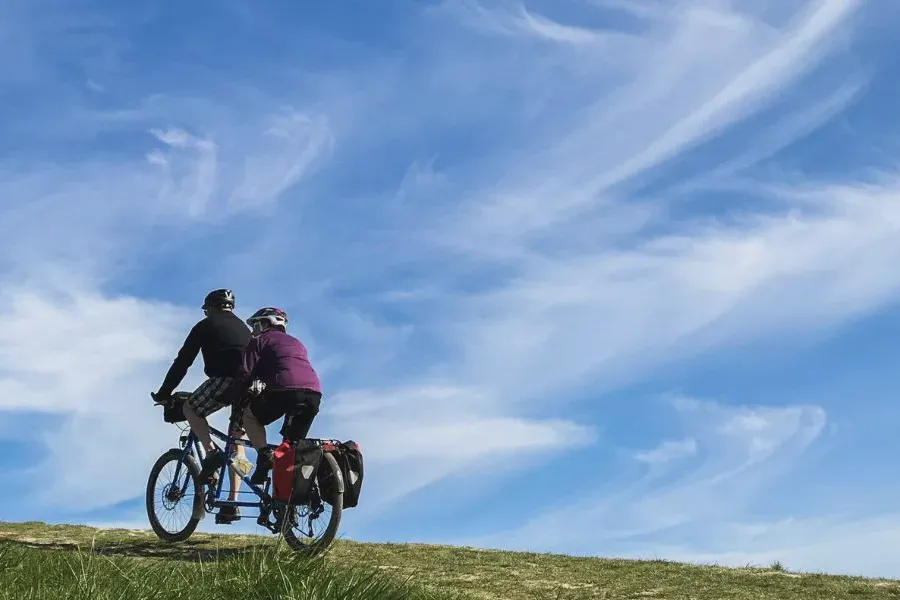
A tandem looks like a normal bike that got stretched in Photoshop, but the way it functions is surprisingly simple. The person up front is the captain: they steer, brake, shift gears, and do all the actual work of keeping the thing upright. The person in the back is the stoker: they pedal, provide moral support, and occasionally shout, “Are you sure about this?” This setup is what makes tandems perfect for non-riders. The captain handles all the balance and decision-making. The stoker just has to keep their feet moving and resist the urge to lean dramatically like they’re on the Titanic. In practice, it means someone with zero bike-handling skills can still enjoy the ride, without steering you into a tree.
What the captain needs to do
If you’re the cyclist in this equation, you’re automatically the captain. That means the responsibility for balance, steering, braking, and generally not turning this experiment into a viral crash video falls entirely on you. Riding solo, you can wobble, swerve or stop suddenly without consequence. On a tandem with a non-rider, every twitch gets magnified and sent straight to the nervous system of the person behind you.
Your first job is to project confidence. Smooth starts, steady balance, and gentle stops will convince your stoker that they’re in safe hands. Drop the bike once at the start, and you’ll spend the next month hearing about it at family dinners. Communication is just as crucial. Tell them what’s coming: corners, bumps, stops. Say it early, say it clearly, and for the love of Odin, don’t shout “Bump!” right as you hit it.
Finally, pace matters. Don’t blast off like you’re chasing a Strava KOM. Start easy, find a rhythm, and keep it steady. Your stoker isn’t trying to survive interval training; they’re trying to survive the idea of being strapped to a moving machine with no control. If you ride like a calm, collected pilot, they’ll relax into it. If you ride like a caffeinated hamster on a power-enhanced spinning wheel, they will never get back on again. You will also need to communicate your living arrangements with your dog for the next few months, as you will be taking over their doghouse.
What the stoker has to know
Being the stoker (the rider in the back) sounds like an easy job. No steering, no braking, no gear shifting. Just sit there and pedal, right? Well, yes and no. A good stoker makes the difference between a smooth ride and something that feels like a circus act on wheels.
The first rule is to stay steady. Leaning suddenly to look at a squirrel or shifting your weight like you’re stretching in yoga will send the whole bike wobbling. Keep yourself centred, relaxed, and predictable. The second rule is to pedal. You don’t have to crush it, but you do need to keep some rhythm going. Nothing confuses a tandem more than one person pedalling while the other decides to take a break mid-hill.
Most importantly, the stoker has to trust the captain. You won’t have brakes or handlebars, and yes, that feels unnatural at first. But the whole point of a tandem is that the person up front handles the scary parts while you get to enjoy the view. Think of it as a backstage pass to cycling: no pressure, all access, and the occasional adrenaline spike when the captain takes a corner a little faster than you’d prefer.
How to handle it to make it fun?
Rule number one: if the non-rider doesn’t want to try, don’t force it. A tandem without consent isn’t “bonding”. It’s a kidnapping simulation, albeit a weird one. If they’re willing, start small. Keep the first ride short: 20 km or 2 hours max. Keep it flat with only the kind of “hills” you could also describe as speed bumps. Avoid traffic entirely. Parks and bike paths are perfect. Highways and busy streets are basically a live-action insurance claim. Keep the pace slow and steady. Don’t hammer, don’t chase KOMs, don’t suddenly decide this is the perfect time to win the Škoda Green Jersey. You’re here to share the ride, not to prove they’re unfit. And please: if your stoker is twice your weight, think twice. You can’t “balance it out” with positive vibes when they panic-lean in the wrong direction.
Before heading out, do a practice run in a big open space. Ride slowly, corner gently, and let them feel how the bike moves. Explain that they should lean with you, but not like a MotoGP rider trying to scrape a knee. Communicate constantly: starts, stops, corners, bumps. Think flight attendant, but with more sweat and less alcohol service. And, above all, set no expectations. This isn’t training, this isn’t a test. It’s about having fun, even if “fun” looks like pedalling at walking speed while your stoker laughs nervously. If you manage to both stay upright and still like each other at the end, that’s already a victory.
Why it’s worth trying
A tandem ride with a non-rider isn’t just possible. It’s genuinely fun. It’s a rare chance to share your passion with someone you care about without dragging them into the deep end of cycling culture. No Lycra lectures, no watt-measuring, no terrifying mountain descents. Just two people, one bike, and the occasional wobble that turns into laughter instead of trauma.
It works because the tandem does the hard part for you: it balances skills, splits the effort, and forces teamwork in the best possible way. For the non-rider, it’s a gentle introduction to the joy of moving on two wheels. For the rider, it’s a reminder that cycling doesn’t always have to be about speed, distance or suffering. Sometimes it’s just about doing something silly and memorable together.
That said, save tandem riding for when you know each other a little better. A first date on a tandem is less “romantic adventure” and more “improvised trust exercise with screaming”. Once you’ve got some rapport, though, it’s one of the most fun cycling experiences you can share – proof that two people pedalling in sync can be just as good as one.